
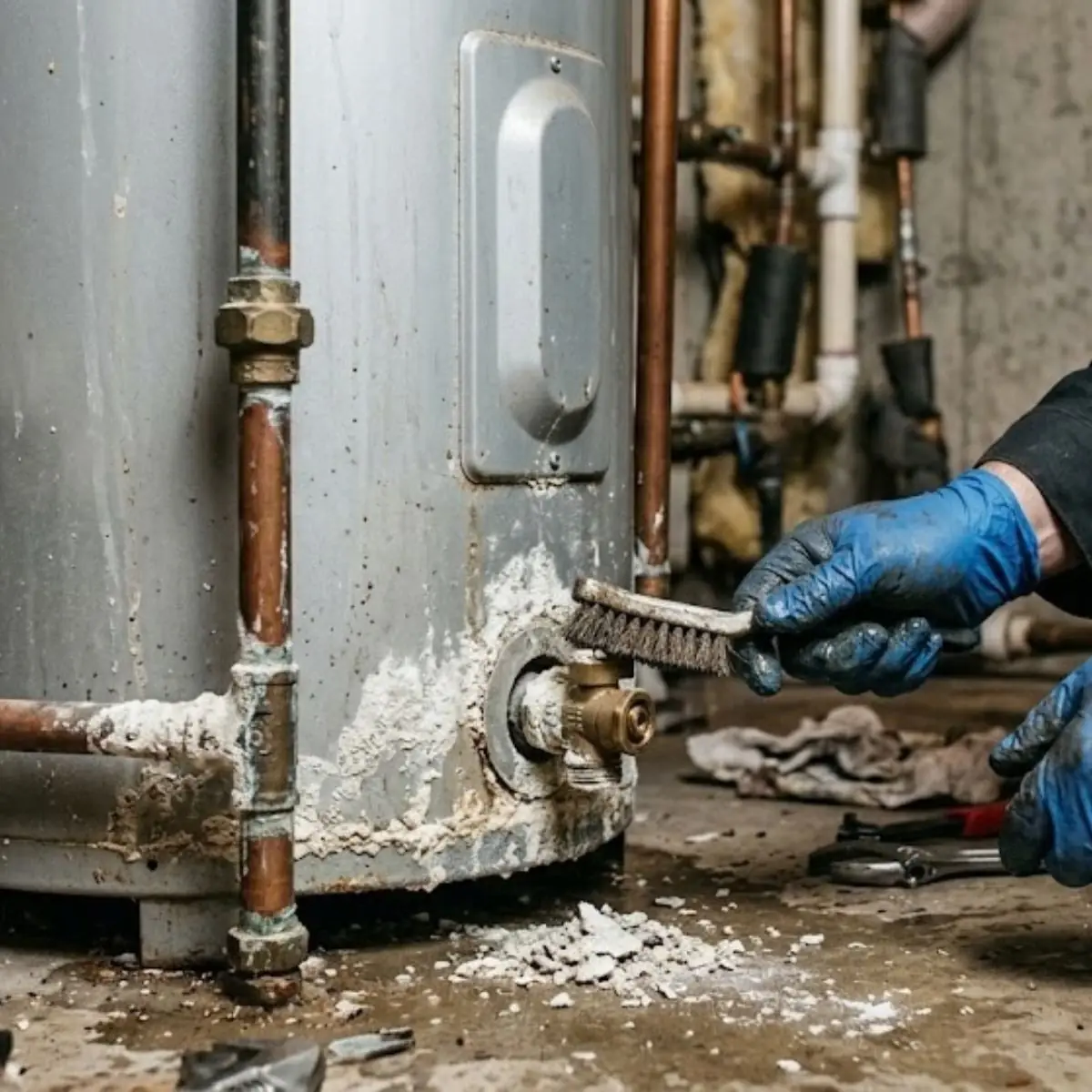
An electric water heater has two heating elements, one near the top of the tank and one near the bottom. When one fails, the usual symptoms are lukewarm water, hot water that runs out fast, or no hot water at all. Replacing an element is a repair many homeowners can do, but it involves 240 volt power and a tank full of water, so the order of steps matters.
This guide covers how to confirm the element is the problem, how to replace it safely, and when to stop and call a plumber. If the tank itself is leaking, a new element will not help, and water heater replacement is the next page to read.
Diagnosis.
Signs the element has failed.
| What you notice | What it usually means |
|---|---|
| No hot water at all. | Upper element or upper thermostat failed, or the breaker has tripped. |
| Lukewarm water that never gets hot. | Lower element failed, or the upper element is working alone. |
| Hot water runs out quickly. | Lower element failed, so only the top of the tank is heating. |
| Breaker trips as soon as it is reset. | A shorted element or a wiring fault, call a plumber or electrician. |
Before opening anything, check the breaker and the red reset button on the upper thermostat behind the access panel. Do that only after the power is off. If the reset button has tripped, a failed element or thermostat is likely, and the reset alone will not last.
Before you start.
Tools and parts you need.
- A replacement element with the same voltage, wattage and mounting style as the old one. The numbers are printed on the heater's label and on the element itself.
- An element wrench, which is a socket made for these screw-in elements, usually 1-1/2 inches.
- A non-contact voltage tester and a multimeter set to ohms.
- A garden hose, a bucket and a flathead and Phillips screwdriver.
- A new gasket if the element does not include one.
Steps.
How to replace the element.
Turn off the power and prove it.
Switch off the breaker for the heater. Remove the access panel and insulation, then use a voltage tester on the wires and terminals to confirm they are dead. Never rely on the breaker label alone.
.Shut off the water and drain below the element.
Close the cold water valve above the heater. Open a hot tap in the house, attach a hose to the drain valve and drain until the water level is below the element you are replacing. For the upper element, a partial drain is enough. For the lower one, drain most of the tank.
.Test the old element.
Disconnect the wires, label them if needed, and touch the multimeter probes to the two terminals. A reading near zero ohms or infinity suggests a failed element. A good element usually reads somewhere around ten to fifteen ohms, depending on wattage.
.Unscrew the old element.
Fit the element wrench and turn counterclockwise. If it is stuck, a firm steady pull is better than a jerk. Clean the gasket surface on the tank.
.Install the new element.
Fit the new gasket, thread in the element by hand, and tighten it with the wrench until snug. Do not overtighten. Reconnect the wires to the terminals.
.Refill before restoring power.
Close the drain, open the cold valve and leave a hot tap open until water flows steadily, which means the tank is full and the air is out. A dry element burns out within seconds.
.Restore power and test.
Replace the insulation and the panel, switch the breaker on, and give the tank time to heat. Check for leaks around the element.
.
Stop and call a plumber if.
The tank has been leaking, the element will not turn, the wiring looks burnt or you are not sure the power is off. A burnt wire or a wet panel is not a DIY job.
Decision guide.
When replacing the element is not worth it.
Element replacement is a sensible fix on a tank under about eight years old. On an older tank, sediment may be insulating the lower element, and a flush is part of the repair. If the tank is rusted around the base or the age is past a decade, a repair may only buy a few months. A plumber can look at the whole unit and give you an honest view. If the problem is the thermostat, the element or the wiring, water heater repair covers it.
What Salem homeowners should know.
Salem tap water comes from the Salem and Beverly Water Supply Board, which treats it with chlorine and fluoride and adds a phosphate to protect pipes. The Board's report does not list a hardness figure, so do not assume scale will be mild or heavy. Look at the old element when you take it out. A crust of white or brown scale tells you what the tank has been dealing with.
Plumbing permits in Salem are filed through the city's Inspectional Services portal. Replacing a heating element is a maintenance repair, but replacing the whole heater is permitted work. If you are unsure, the permit office at 978-619-5641 can answer questions.
Maintenance.
Flushing the tank while you are in there.
Because the tank is already partly drained, it is a good moment to flush sediment. Open the cold supply briefly with the drain open, and let the water run until it clears. Sediment on the tank floor makes the burner or the lower element work harder and shortens life.
If you rely on an electric heater in a Salem basement, set it on a stand or in a pan with a drain line. Damp concrete corrodes tanks from the bottom, and a pan catches the first weeping before it becomes a flood. For help beyond the element, our team also serves Beverly and nearby towns.
Before you start.
Safety and code notes.
Replacing an element is electrical work on a pressurized tank. Most manufacturers say to shut off the breaker, confirm the power is off with a tester and drain the tank below the element before opening the panel. Plumbing work in Massachusetts follows the standard set by 248 CMR 10.00, and electrical connections follow the state electrical code, so if you are not comfortable testing for voltage, call a licensed professional.
Questions.
Water heater element questions from Salem homeowners.
Many homeowners can, if they confirm the power is off with a voltage tester and refill the tank before restoring power. If you are not comfortable with 240 volt wiring, call a plumber.
Often many years, but scale and sediment shorten the life, and replacement is common after eight to twelve years.
Not always. Many plumbers replace both when the tank is already drained, since the second is close to the same age.
Mineral scale does. The Salem and Beverly Water Supply Board's report does not list a hardness number, so inspect the old element for scale and flush the tank on a schedule.
The thermostat or a wiring fault may be the cause, or the tank may be failing. A plumber can test the thermostat and wiring.